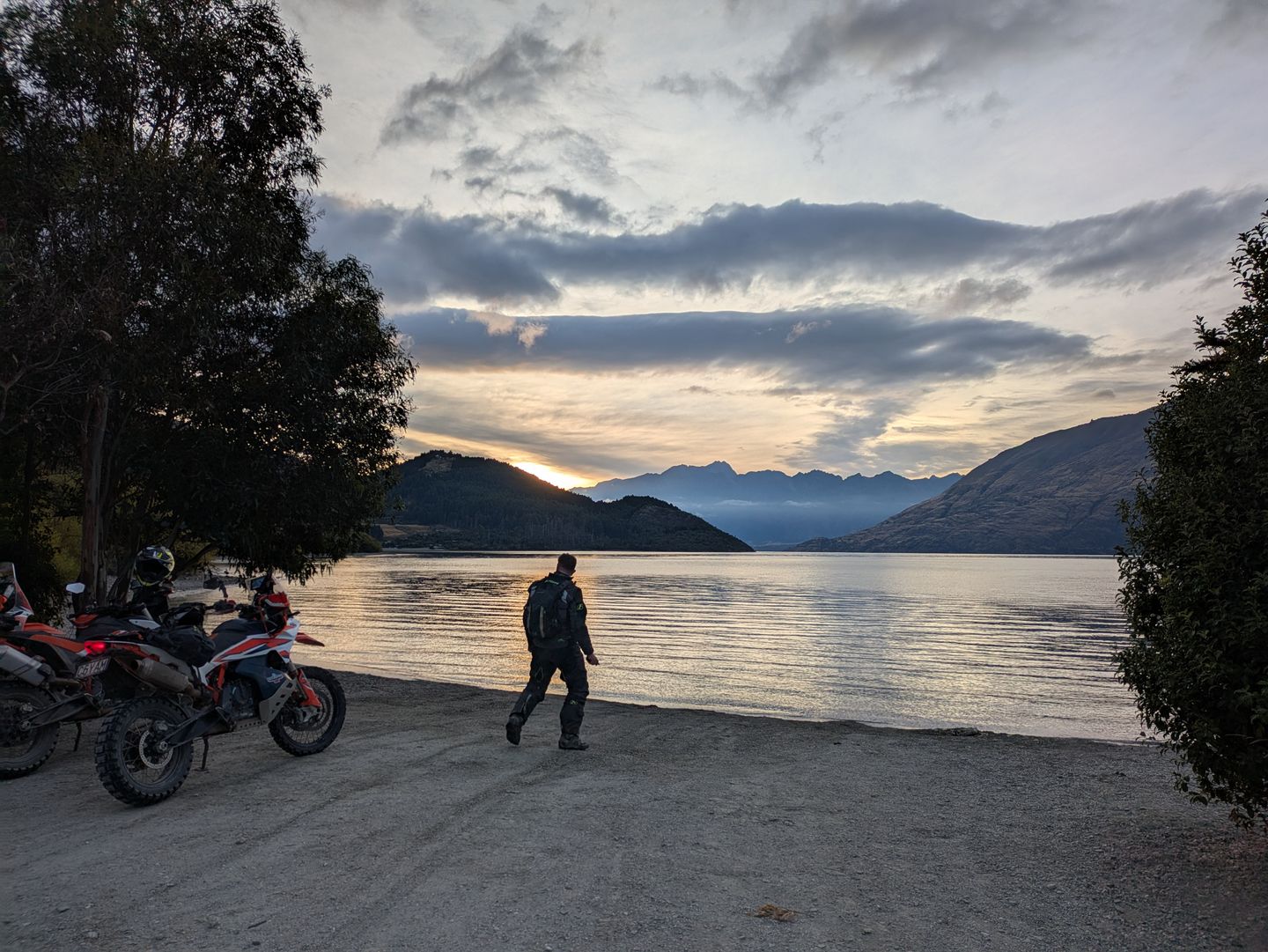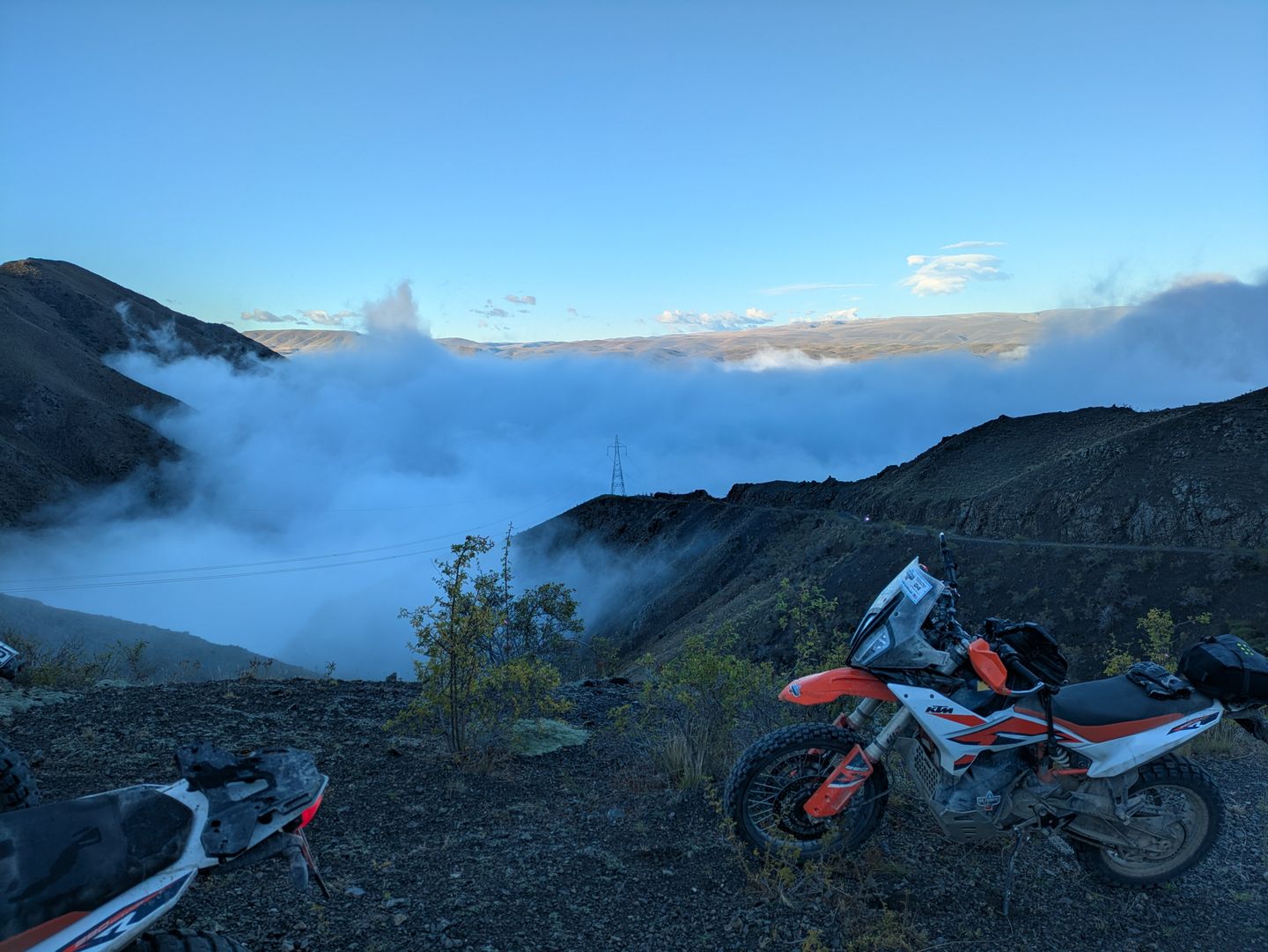
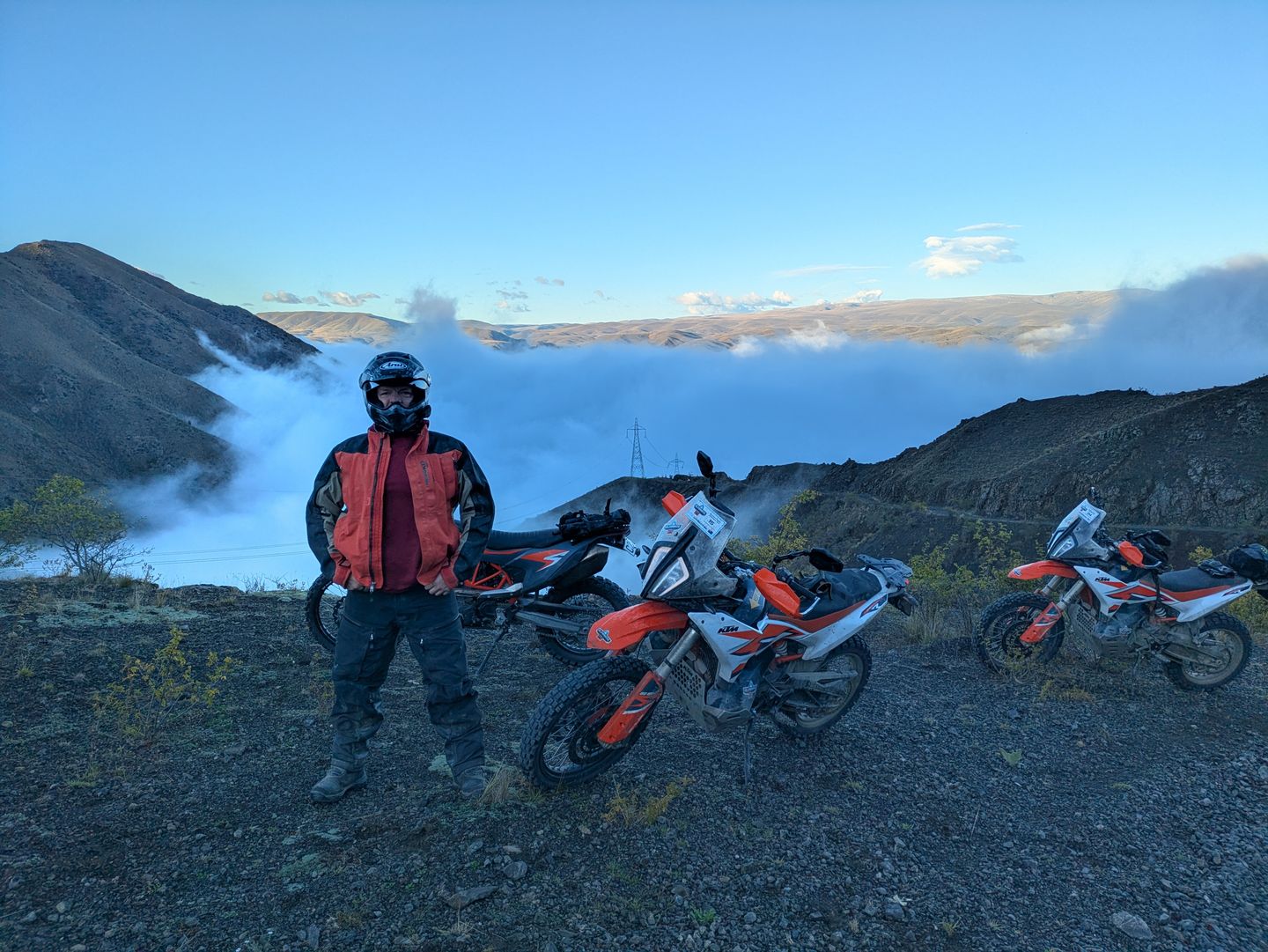
The cloud was in the valley when we got to the top. Not above it, the way clouds are supposed to be. In it — sitting flat across the floor of the basin like someone had poured milk into a bowl and forgotten about it for an hour. The sun was coming up behind us, low enough to light the far ridges orange while leaving the cloud underneath the color of old bone.
I killed the engine and sat there for a long minute, helmet still on, listening to nothing in particular. Eight thousand miles is a long way to come to sit on a hillside, and it occurred to me that I had no idea what time zone my body was on.
We were a week and a half into a guided ride through the South Island of New Zealand. KTMs — a mix of 690s and the big 1290 Super Adventures, depending on what you'd booked — running an itinerary that the operator called "Southern Passes" and which the locals seemed to call "the long way around." Twelve days of riding, give or take a rest day. Mostly gravel. A lot of it the kind of gravel that pretends to be a road and then doesn't.
The country comes at you differently
The first thing you have to get used to in New Zealand, if you've spent your riding life on the right side of the road, is the perfectly reasonable but completely unsettling fact that you are now on the left. This is fine in theory. It is fine on a quiet straight. It is meaningfully less fine the first time you come around a blind right-hand bend at speed and your body, on its own initiative, tries to set up for the apex on the wrong side of the centerline.
I learned this on day two, on the section between somewhere and somewhere else. The body relearns. The hands sort themselves out. By the end of the second day you've stopped flinching every time you pass a truck.
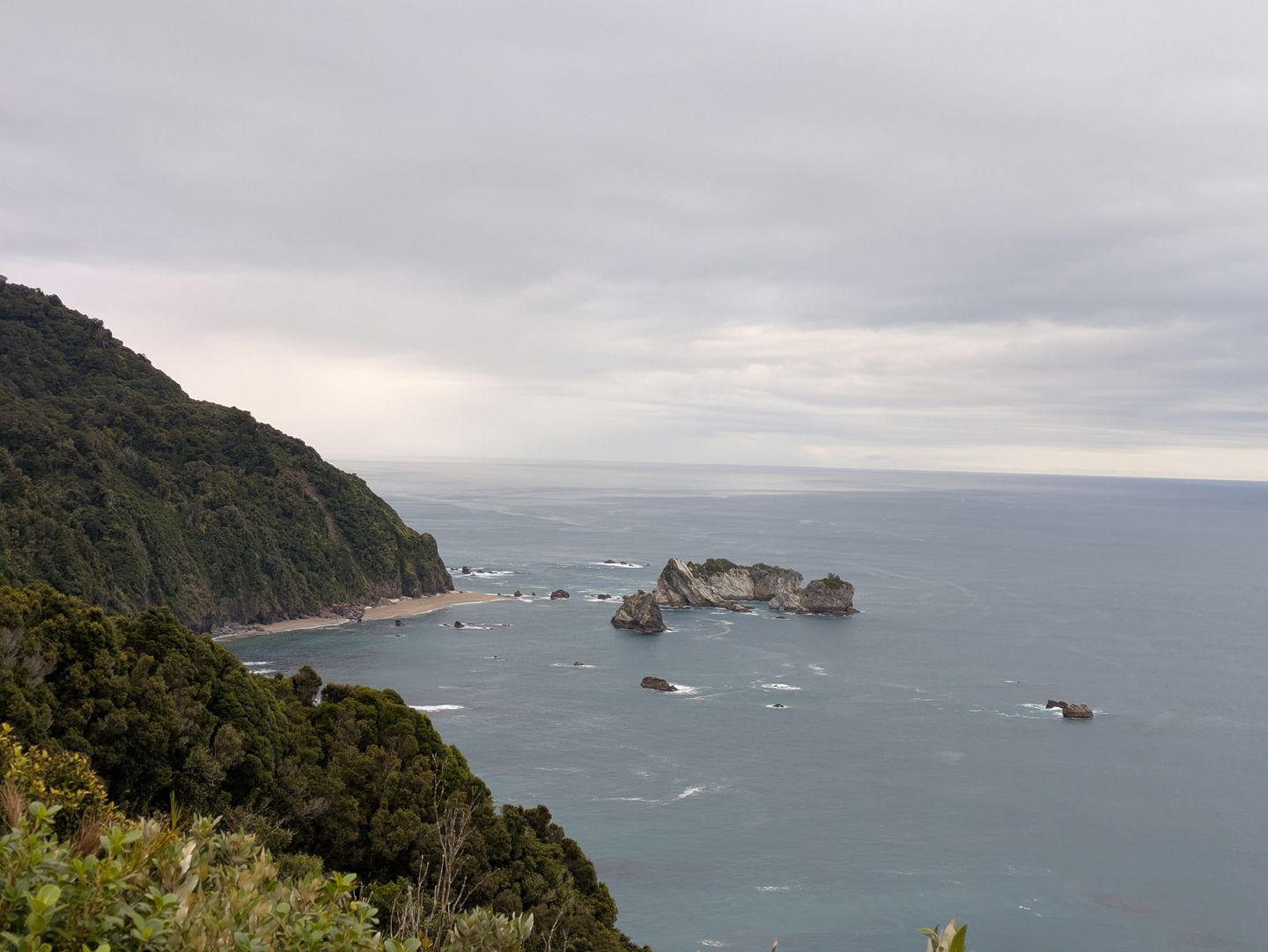
The other thing you have to get used to is that the country is small in a way that doesn't track with the map. You ride for forty minutes and you've crossed a climate. You leave a town under sheep-pasture cloud and you crest a ridge into rain-forest-blackbird-and-fern. The roads change with the country. Tarmac becomes graded gravel becomes washboard becomes loose, fist-sized rock that makes the bike a thing you are negotiating with rather than steering.
Mornings
The mornings were the part I'd come for, although I didn't know that yet on day one.
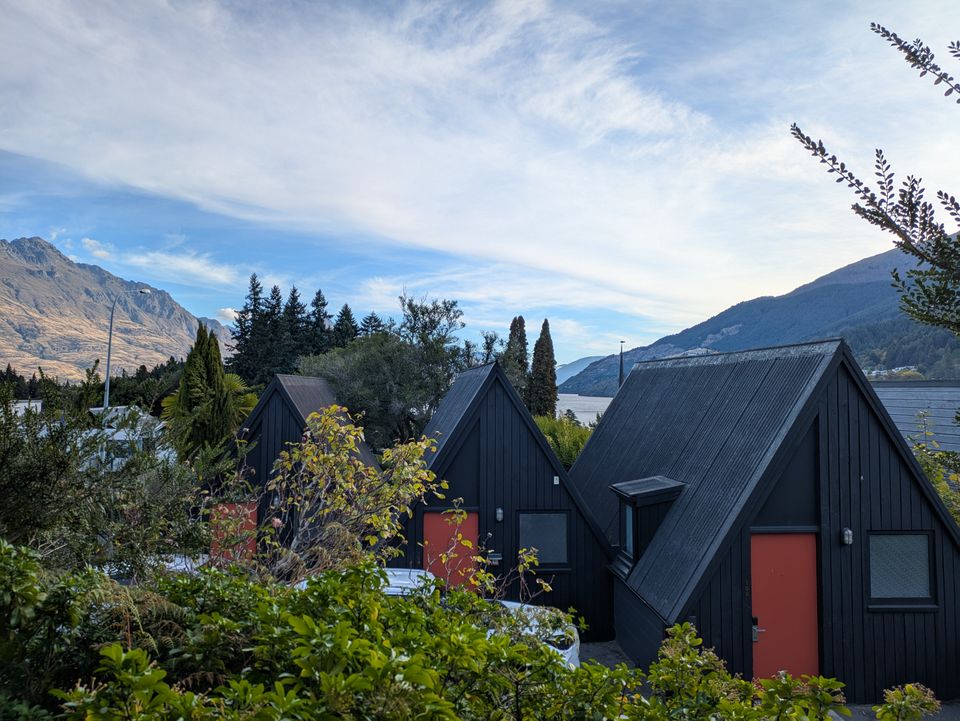
You're up early because the light is. You suit up in a hut or a cabin or a small motel that smells faintly of damp wool. You walk out to the bikes lined up in the gravel lot under a sky that's still mostly stars, and somebody — whoever drew that day's pre-flight — has already pulled the covers and checked the tires. Helmet on. Glove on. Glove on. Key. The starter motor's small electric whine, and then the deep clatter of a single-cylinder thumping awake in cold air.
You don't talk for the first hour. Not because you've agreed not to. Just because there's nothing to say yet.
It's in those hours that the country turns into the postcard everyone tells you it is. The light comes up over a range you don't know the name of. Steam comes off a creek. A hawk does a slow figure-eight a thousand feet above the road and doesn't beat its wings the whole time you watch. You ride past a paddock where five hundred sheep regard you with the kind of bored contempt that only sheep can really manage.
By the time you get to wherever you're stopping for breakfast — usually a bakery in a town small enough to count as a single intersection — your hands are stiff and your face is cold and you've forgotten what month it is. The bakeries are good. They are all good. There is no bad bakery in the South Island of New Zealand.
Eight passes
I am not going to list the passes in order. I will get them wrong, and someone who lives there will read this and wince. What I can tell you is that they came in waves of three or four a day, and that they had a rhythm.
The named ones — Lindis, Crown, Haast, Cardrona — show up on the tourist maps. They are paved or mostly paved. They are the ones the campervans do. We did them, too, because you have to: they are the connective tissue of the South Island, and you can't get from one good gravel section to another without crossing them.
It was the un-named ones that did the work. The eight-kilometer sidings off a back road that climbed a thousand meters in twenty minutes and dumped you onto a tussock plateau where the only thing tall enough to see was a single trig point. The valleys where the road was just a line some farmer had decided to drag a grader along once a season. The pass we did on the morning of day eight that wasn't on any map I'd seen, where the cloud was in the valley, where I parked the bike and sat down on the dirt and didn't say anything for a long time.
The bike kept making the small tick-tick-tick noises a hot engine makes when it's cooling. The riders behind me caught up one at a time. Nobody said anything either. We sat there until the cloud started to lift, and then we put our helmets back on and rode down into it.
The town where the saloon was yellow
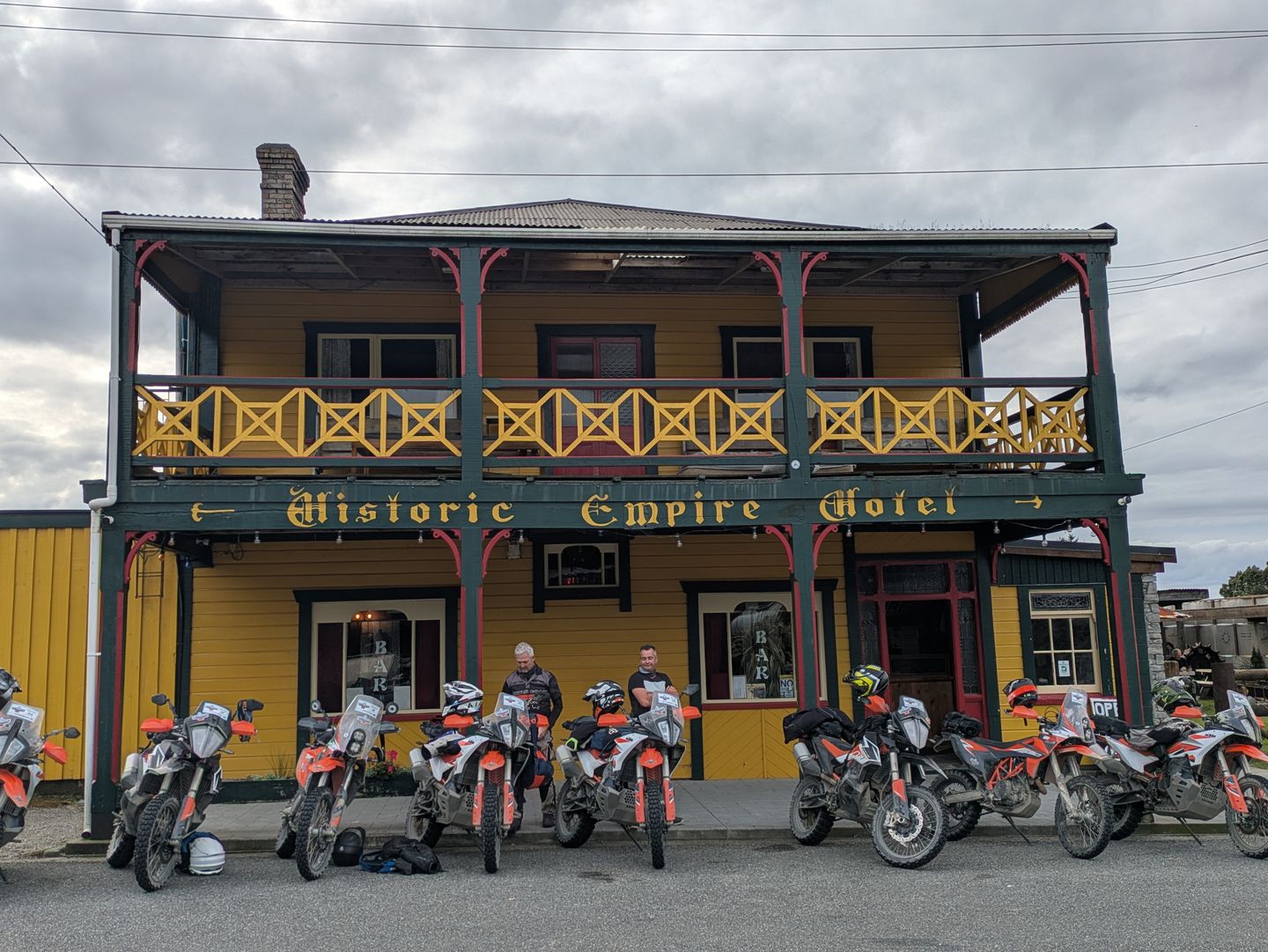
Somewhere in the middle of the trip there was a town, and the town had a saloon, and the saloon was painted bright yellow.
I'm being vague because the country is full of these towns, and they all look like one another and none of them do. They were goldfield towns once. The gold ran out a long time ago and the towns stayed because somebody had to. Most of them have one pub, one bakery, one general store, one cemetery on a hill that's older than any country I'm used to thinking of as old.
We pulled in around lunch. Eight KTMs in a line outside the saloon. A guy on the porch in a wool jacket nodded at us without ever taking the cigarette out of his mouth. We ate inside. The food was hot and the beer was cold and the woman who ran the place had three things on the chalkboard, all written in the same handwriting that she had probably been using to write the menu on that chalkboard for forty years.
I have been in a lot of places that wanted to be photographed. This was a place that was indifferent to being photographed, which is rarer and better.
The waterfall
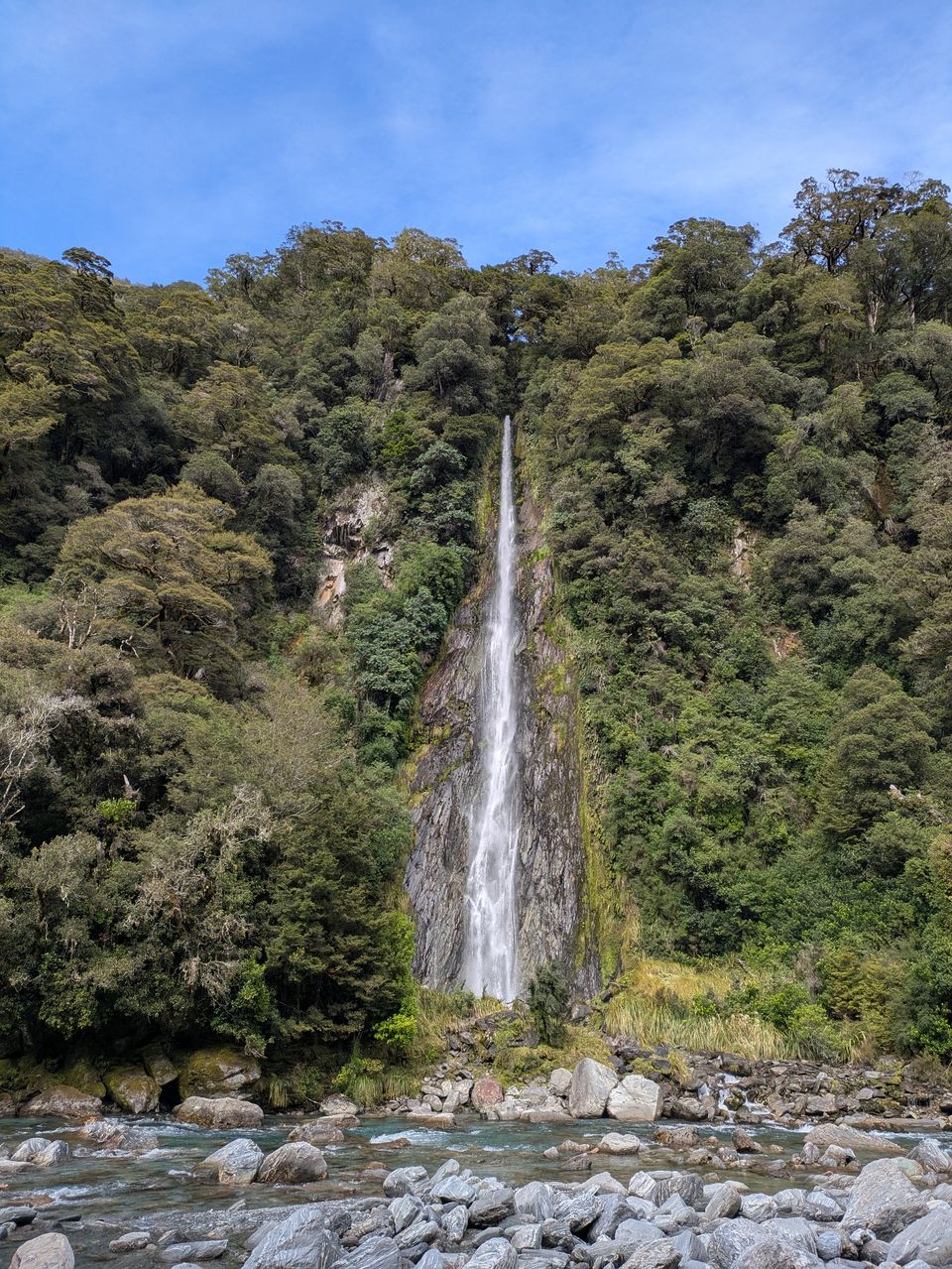
There was a waterfall on day six. I don't remember what it was called and I'm not going to look it up because I want to remember it the way I remember it, which is: tall, narrow, white, cutting down through a wall of ferns into a creek so cold it made your teeth ache to drink from it.
The path in was short. The bikes stayed at the parking lot. I walked down to the river beach below the falls and stood on rocks that have been bowling-ball-smooth for ten thousand years.
It was the only place on the trip where I took my phone out and didn't take a picture for a while.
Later I took one. It's not as good as standing there was, but no picture ever is.
What you bring home
There's a question you get when you come back from a trip like this. It's always some version of: was it worth it.
The answer is yes, of course. It's always yes. The real question is what you brought back.
I brought back: a slightly different sense of distance. A grudging respect for the kind of weather that lives at forty-four degrees south. A new bias in favor of bakeries in towns of fewer than four hundred people. The memory of a cloud sitting in a valley at sunrise and a group of grown adults sitting on the dirt around it not saying anything.
I also brought back the bike's smell on my riding gear, which lasted about three weeks before the wool jacket lost it to the wash. By then I had already started looking at the next map.